


Does anyone have shots or slides of airliners in sports colors save for the america west 57's? I think thus so far I have found the most beautiful of them all.
http://www.airliners.net/open.file/0105591/M/




Does anyone have shots or slides of airliners in sports colors save for the america west 57's? I think thus so far I have found the most beautiful of them all.
http://www.airliners.net/open.file/0105591/M/
Southwest Airlines-"Once it pop's it's time to stop" Southwest Airlines-"Our Shamu's are almost real" Southwest Airlines -"We blow our top real easy" Southwest Airlines- "You can't top us..... really"

I'm not a sports person and I don't know what half the teams I shoot are but I will shot a sports aircraft just as fast as any other. Only put up the ones with themed colorschems and not untitled charters.
Senga
Great collection Senga! God I remeber Tdubs helmet birds. The 757 looked mean with the helmet on. Oh man what awsome birds those were.
I saw it at STL once but didn't want to take a risk to get it..I kind fo regret that now.
I should have some more around ehre somewhere. It seems liek a lto fo these sports teams are not taking generic charters around instead of their themed planes.
Senga
Anyone got some 707 charters?
Senga
I have to look but I have some really old stuff from when I was a kid of a 707 that was basically on wooden blocks with dodgers colors on it from out west.
Southwest Airlines-"Once it pop's it's time to stop" Southwest Airlines-"Our Shamu's are almost real" Southwest Airlines -"We blow our top real easy" Southwest Airlines- "You can't top us..... really"
They actually used a 720 (very similar to the 707, but less range). I remember seeing it at JFK in the late '70s several times when the Dodgers were in to play the Mets.Originally Posted by hiss srq
Here's a photo (not mine) on jp.net:
http://jetphotos.net/viewphoto.php?id=45779
Here's a later look at her:
http://jetphotos.net/viewphoto.php?id=192570
KC-135 - Passing gas & taking names!
http://www.jetphotos.net/showphotos.php?userid=15086
http://moose135.smugmug.com
yeah thats her. And that is an intresting note the 720 707 diffrence I can never tell which is which and nordid I know the diffrence.
Southwest Airlines-"Once it pop's it's time to stop" Southwest Airlines-"Our Shamu's are almost real" Southwest Airlines -"We blow our top real easy" Southwest Airlines- "You can't top us..... really"
Not much of a difference, really. The 720 is a touch shorter than the early 707, and had some wing design changes. It had a lower fuel capacity, hence a shorter range than the 707. Externally, there's not much to tell them apart, and inside, they are nearly identical (same cockpit & passenger cabin).
KC-135 - Passing gas & taking names!
http://www.jetphotos.net/showphotos.php?userid=15086
http://moose135.smugmug.com
The 720 was Boeing's piss poor answer for a short to medium range aircraft. Its performance was rather lack luster and it sucked fuel.
would my assumption be correct that it was a fanjet?
Southwest Airlines-"Once it pop's it's time to stop" Southwest Airlines-"Our Shamu's are almost real" Southwest Airlines -"We blow our top real easy" Southwest Airlines- "You can't top us..... really"
Actually from what I read, the redesigned wing gave it a higher cruise speed and a slower landing speed, allowing it to get into shorter fields.
The early ones had the straight-jet, but with the lower max t/o weight didn't have water injection. I later ones (and some converted ones) had fans.
KC-135 - Passing gas & taking names!
http://www.jetphotos.net/showphotos.php?userid=15086
http://moose135.smugmug.com
I wish I was around for the old water wagons . I have been told they were the loudest things on the planet. Moose could you explain exactly how the whole water injection system worked?
Southwest Airlines-"Once it pop's it's time to stop" Southwest Airlines-"Our Shamu's are almost real" Southwest Airlines -"We blow our top real easy" Southwest Airlines- "You can't top us..... really"

Regarding the 720, principal operators were American, Avianca, Braniff, Continental, El Al, Ethiopian, Eastern, Aer Lingus, Luftansa, Northwest, Pacific Northern (who's that?), Pakistan, Pan Am, Saudi Arabian, United and Western.
The 720B was turbofan version. AAs were converted.
hiss - those were the days no doubt. Many seem to remember the roars of those days similar to the thunder we might hear from military aircraft at airshows these days, but actually the high pitched screeches and whines of those early jets - BAC 1-11s, Caravelles, Convair jets etc. at the gates and taxiing were ear splitting and painful if you were close enough.
Senga - great convair prop. I take it you shot that in Chicago or thereabouts?
Tom
"Keep 'em Flying"
OK, you asked for it :D
On the KC-135 (and I assume the 707 with the original turbojets, it was basically the same engine) water was injected into the inlet and diffuser areas of the engines. This did two things, it reduced the temperature of the combustion chamber, allowing more fuel to be introduced, and it also increased the density of the incoming air. This gave an additional 2,000 lbs. of thrust per engine (compared to 10,500 lbs. each max dry thrust).
The KC-135 had a water tank in the lower fuselage, located between the main gear wells. It held 670 gallons (approx 5,600 lbs.) of water - in normal operations we used demineralized water to keep from clogging the nozzles. The -135 used two pumps to inject the water. The original design had one providing water to the port engines, the other to the starboard engines. It soon became apparent that wasn't a good idea, and it was soon changed to have one pump for the inboard engines and the other for the outboards, to avoid asymmetrical thrust if one pump failed.
During preflight (or during your daily walk-around when sitting alert) you would check the quantity with a sight gage in the starboard wheel well. We could use water for take off in outside temperatures down to 20F. There were heaters in the tank, and when it was below 40F, we would use the heaters to keep the temp up. When preparing for a flight this wasn't really an issue, it was more important when pulling alert. When the temp was between 20F and 40F, the crew chief would be in and out of the alert facility to the jet, monitoring the water temp and starting & stopping the ground power unit to run the tank heater. There were many times as the temp fluctuated around 20F that we would dump the water, only to refill it again the next day.
When making a wet takeoff, we normally lined up, pushed up the power part way ("stood up" the throttles) and as co-pilot, I would hit the water-start button. We would look for an increase in fuel flow & engine pressure ratio (EPR). Once we knew we had water flow, the pilot would push up the throttles to takeoff setting. On a dry take-off, we would have an EPR in the 2.20 range, for wet take-offs, we used an EPR of 2.83 The 670 gallons of water would last us approx 2 minutes, which would get us through takeoff and flap retraction.
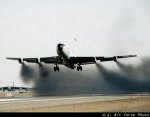
In addition to the increased sound, the easiest way to tell a –135 was making a wet takeoff was the huge cloud of black smoke. The photo in my avatar shows a wet takeoff. One of the things we did from time to time was a minimum interval takeoff (MITO) where we would take off in sequence with a 12 second interval between tankers. We did this to practice in case we ever needed to launch during alert. Being number 2 (or 3 or 4) in a wet MITO takeoff was certainly exciting!
We didn’t use wet takeoffs all the time (well, certainly never in cold temps) but it was used when necessary based on temp and takeoff weight. On a hot (or even warm) day with a heavy fuel load, the KC-135 didn’t have especially brisk takeoff performance. The heaviest weight takeoff I remember flying was out of Pease AFB, NH, dragging a flight of F-4s to England. Our takeoff weight was 285,000 lbs. (meaning we had about 175K lbs. of fuel). That compares to a maximum takeoff weight of 297,000 lbs. We never saw that kind of weight except when on alert, and never had to launch at that weight. (On alert, with 12,000+ ft of runway, we didn’t have 3-engine capacity, meaning if you lost an engine after V1, you were screwed!) On that Pease takeoff, we pushed up the power, hit the water switch, and went lumbering down the runway, watching the distance remaining markers go past seemingly faster than the airspeed was increasing. Somewhere around 10,000 feet, we rotated, and got airborne with less than 1,000 feet of runway left.
KC-135 - Passing gas & taking names!
http://www.jetphotos.net/showphotos.php?userid=15086
http://moose135.smugmug.com
 Posting Permissions

 Reply With Quote


Bookmarks