
On This Day in Aviation History

2014-11-18

Today in Aviation History: November 18th

2009 – Virgin America commences service between their San Francisco (SFO) hub and Fort Lauderdale (FLL), as well as LAX-FLL.

2002 – American Airlines and British Airways announce their plan to launch codeshares on transatlantic flights, a plan that would be essentially derailed by U.S. regulators.

1997 – The FBI concludes its investigation of the TWA Flight 800 crash, declaring there is no evidence of foul play. The NTSB’s investigation would continue.

1985 – General Dynamics completes its purchase of Cessna. (Cessna would be sold to Textron in 1992).

1985 – Space Shuttle Enterprise, is ferried from Kennedy Space Center in Florida to Washington Dulles Airport for display at the National Air and Space Museum’s Steven F. Udvar-Hazy Center.

1966 – The North American X-15 rocket plane, piloted US Air Force Captain William J. Knight, sets a speed record of Mach 6.33 (4,250 mph, 6,840 km/h).

1955 – The Bell X-2 rocket plane makes its first powered flight.

1949 – A C-74 Globemaster delivers 103 passengers across the Atlantic, a record load for a transatlantic flight.

1943 – The Battle of Berlin begins, with 440 Royal Air Force planes bombing the German capital, though causing only moderate damage. 131 Germans are killed, while the RAF loses nine aircraft and 53 air crew. The bombing continues until the end of March 1944.

1930 – Boeing’s first monoplane fighter aircraft, the XP-9, makes its first flight at Wright Field in Dayton, Ohio. The design is almost immediately rejected by Army test pilots: The wing’s placement atop the fuselage in front of the cockpit severely obstructs visibility to the point that landing is dangerous. The plane is also inherently unstable, resulting in a demand for a larger tail. Even with the tail modification, the single copy of the aircraft is retired the following year after just 15 hours of flight time.

1923 – Alan Shepard, American astronaut, was born. Shepard was the first American in space. He later commanded the Apollo 14 mission, and was the fifth person to walk on the moon.

About the Author

admin


Today in Aviation History: January 6

Happy birthday to Lufthansa! United Grounds Ted, the US Marines take delivery of their first AV-8 Harrier and more...
by NYCAviation Staff


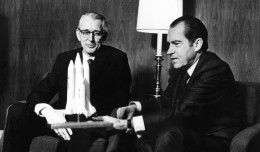
President Richard M. Nixon and Dr. James C. Fletcher, NASA Administrator, discuss the proposed Space Shuttle vehicle in San Clemente, California, on January 5, 1972. (Photo by NASA)

Today in Aviation History: January 5th

The Space Shuttle program is launched, Amelia Earhart is declared legally dead, Independence Air ceases operations, and more...
by NYCAviation Staff


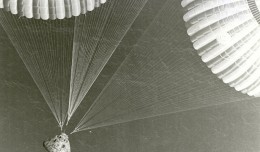
The Apollo 17 spacecraft, containing astronauts Eugene A. Cernan, Ronald E. Evans, and Harrison H. Schmitt, glided to a safe splashdown at 2:25 p.m. EST on Dec. 19, 1972, 648 kilometers (350 nautical miles) southeast of American Samoa. The astronauts were flown by recovery helicopter to the U.S.S. Ticonderoga slightly less than an hour after the completion of NASA's sixth and last manned lunar landing in the Apollo program. (Photo by NASA)

Today in Aviation History: December 19th

The world's first airport opens near Paris, the last moon mission returns to earth, a Chalk's Ocean Airways crash is captured on video, and more...
by NYCAviation Staff


Today in Aviation History: December 16th

The midair collision of a United DC-8 and TWA Constellation over New York City, Concorde makes the first sub-3-hour Atlantic crossing, an Air Canada CRJ crashes, and more...
by NYCAviation Staff
726


Today in Aviation History: December 15th

In a near disaster, KLM Flight 867 loses all engines temporarily after flying through a cloud of volcanic ash, McDonnell Douglas and Boeing merge, the Boeing 787 makes its first flight, and more..
by NYCAviation Staff


  • As
    I was saying, there is a little something for everyone in the great city of San
    Francisco and just because something appeals to a much younger crowd, in no way
    indicates that it can’t appeal just as well to an older or young again crowd.