Search teams were able to recover the body of one of the 228 victims that died during Air France flight 447, which crashed in the Atlantic Ocean in 2009 during a scheduled flight from Rio de Janeiro to Paris, French authorities said Thursday.
According to the statement, the body was found still strapped to one of the aircraft’s seats, but the condition of the body was described as ‘degraded,’ as it had remained at the bottom of the sea for almost two years. A DNA sample was retrieved to possibly identify the body.
On Tuesday, France’s Bureau of Enquiry and Analysis for Civil Aviation Safety (BEA) announced that an investigation team localized and identified the aircraft’s Cockpit Voice Recorder (CVR) Monday night, which was later lifted on Tuesday morning.
The recovery came just days after the memory unit of the flight data recorder (FDR) was located in the ocean last Sunday and appeared to be in good condition. The recoveries of the FDR, or black box, and the CVR could finally give investigators the information they need to figure out what caused the crash of flight 447, almost two years later after the incident.
Last week, a twelve-hour long search of the ocean floor near waypoint TASIL led to the discovery of the chassis of the plane’s FDR. But as the crash survivable memory unit was missing, it was of no use to investigators.
Initial investigations have stated that the accident could have been caused by malfunction of the airplane’s speed sensors (Pitot tubes), which would have resulted in inaccurate airspeed data. Others have also said the airline failed to respond quickly to the reports.
On June 1, 2009, an Airbus A330-200 jetliner operated by Air France as Flight 447 and on route from Rio de Janeiro, Brazil to Paris, France crashed near waypoint TASIL in the Atlantic Ocean around three and a half hours after taking off. Five days after the crash, search and rescue teams recovered two bodies and floating debris from the aircraft. Only 51 bodies were recovered after the search was called off on June 27, 2009.
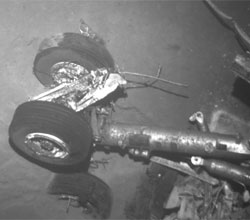
In early April, the aircraft’s wreckage was found during the fourth sea search, which was funded by Air France and Airbus. The recovery gave investigative teams renewed hope to understand the causes of the accident.
The crash marked Air France’s deadliest, and BEA chief Paul-Louis Arslanian called the incident the worst accident in French aviation history.