Aviation News

2010-08-23

Severe Turbulence Forces American Airlines Flight Diversion to Boston

More articles by »
Written by: admin
Tags: ,
American Airlines Flight 172

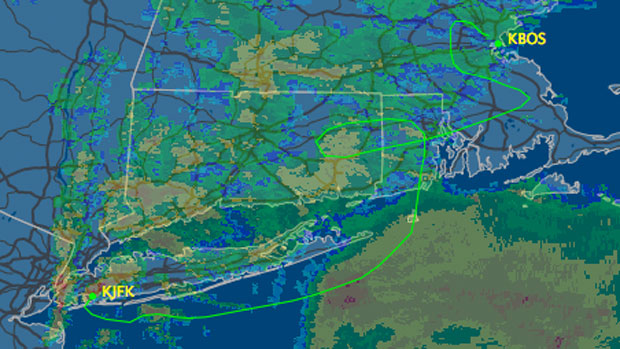
Path of Flight 172 Sunday night. (Courtesy of FlightAware.com)

An American Airlines jet flying from New York-JFK Airport (JFK) to Brussels made an unscheduled landing at Boston-Logan (BOS) Sunday night after flying through severe turbulence. The flight appeared to have flown through strong thunderstorms off the southeast coast of Long Island, according to a FlightAware map.

American Flight 172, a Boeing 757-200, landed safely at 10:40pm. It had departed over three hours late due to strong thunderstorms passing through the area, the same which likely caused the turbulence.

None of the flight’s 159 passengers and nine crew members reported injuries. The flight was scheduled to depart Boston for Brussels at 11:54pm, though this was subject to change.


About the Author

admin


Northern Pacific Boeing 757 with black and white livery on fuselage and tail, aurora borealis inspired splash of color on winglets, and similarly colored N on the tail.

Northern Pacific Airways Unveils First Aircraft

New airline Northern Pacific Airways unveiled their first aircraft on Tuesday evening in an event held at San Bernardino International Airport.
by Rufus Powell
0


Onboard Breeze Airways First Flight From Louisville

Back in June, 2018, the aviation community first heard of a possible new airline, to be partly founded by David Neeleman. The founder of JetBlue Airways, Azul Brazilian Airlines, WestJet, and ...
by Tom Rainey
0


A Step Towards Normalcy At The Jones Beach Airshow

A year after being cancelled at the height of the COVID-19 Pandemic, the Bethpage Federal Credit Union Airshow at Jones Beach returns for 2021.
by Scott Snorteland
0


SWISS Shows Off Its Revamped JFK Lounge

NYCAviation toured the fully-remodeled SWISS International lounge at JFK's Terminal 4
by Eric Dunetz
1


The Future of Business Aviation in Focus at NBAA BACE

The business aviation community will be gathering in Las Vegas this week for the annual NBAA Business Aviation Convention and Exposition (BACE).
by Gabe Andino
1


  • BOB

    Why in the world would they fly through the most severe part of the thunderstorm? How much flying time did those pilots have.Its time to wake up and fly right and remember basic meteorology 101.

    • MrBill

      Hey Bob,
      Somewhere around 20,000 hours for the captain. You can find that out through the FAA website. He also was an aircraft commander having flown weather airplanes for the Air Force. Did you ever consider the jetstream? Guess where it was the night of the incident??? Ever hear of shear related to it?? Airplanes have encountered it from time to time, usually resulting in similar outcomes. Did you consider that the aircraft's systems may have also been compromised as a result of the turbulence and perhaps the plan might have been more prudent to land on terra ferma than continue across the pond at night with nowhere to land after having encountered turbulence that may have resulted in some sort of structural damage that the crew wouldn't know about unless they could visually inspect the entire airplane's hull at altitude which of course would have been impossible not to mention those same systems having problems a few hours later Bob??????????????/

  • BOB

    Why in the world would they fly through the most severe part of the thunderstorm? How much flying time did those pilots have.Its time to wake up and fly right and remember basic meteorology 101.

    • MrBill

      Hey Bob,
      Somewhere around 20,000 hours for the captain. You can find that out through the FAA website. He also was an aircraft commander having flown weather airplanes for the Air Force. Did you ever consider the jetstream? Guess where it was the night of the incident??? Ever hear of shear related to it?? Airplanes have encountered it from time to time, usually resulting in similar outcomes. Did you consider that the aircraft's systems may have also been compromised as a result of the turbulence and perhaps the plan might have been more prudent to land on terra ferma than continue across the pond at night with nowhere to land after having encountered turbulence that may have resulted in some sort of structural damage that the crew wouldn't know about unless they could visually inspect the entire airplane's hull at altitude which of course would have been impossible not to mention those same systems having problems a few hours later Bob??????????????/

  • Travis

    1) What was the altitude of the storm in the radar picture above?
    2) What was the altitude of the aircraft?
    3) Did the aircraft hit the turbulence in clear weather?
    4) Is this a 3d map?
    5) So if a 3d map showed the storm at a low altitude, and the aircraft was far above the storm, and the aircraft was not even flying through any clouds during the turbulence….then your post might be completely inaccurate?

  • Travis

    1) What was the altitude of the storm in the radar picture above?
    2) What was the altitude of the aircraft?
    3) Did the aircraft hit the turbulence in clear weather?
    4) Is this a 3d map?
    5) So if a 3d map showed the storm at a low altitude, and the aircraft was far above the storm, and the aircraft was not even flying through any clouds during the turbulence….then your post might be completely inaccurate?

  • Wxsquirrel

    Yes, we need to remember basic meteorology. The above image attached to this story is very misleading. Just as there is a flight path showing the plane's position with respect to time, the radar image can not be compared, it is just one image and does not show the weather's locations with respect to time as it did with the flight path. The radar image above shows the conditions at the time the plane took off. The storms were moving NE. If you follow the flight path with respect to the comparable radar images (http://www.rap.ucar.edu/weather/radar), this plane did nothing wrong and did a nice job avoiding the weather considering the conditions. The problem here is that the weather extends beyond the clouds and the storms (also, cloud tops need to be taken into account as the previous poster mentioned). Wind velocities can be just as dangerous around a storm in areas of no radar reflectivity. This takes an understanding of meteorology beyond what most pilots receive and can not be detected by traditional aircraft radar. It can also be intermittent, another plane could fly through the same airspace 5 minutes before with no problems.

    I've been on planes with *bleeping* pilots that have purposely flown through severe storms or had no knowledge of their radar and it's attenuation problems, this doesn't look like the case to me. This is more closely related to clear air turbulence. I'm glad to hear everyone was ok.

  • Wxsquirrel

    Yes, we need to remember basic meteorology. The above image attached to this story is very misleading. Just as there is a flight path showing the plane's position with respect to time, the radar image can not be compared, it is just one image and does not show the weather's locations with respect to time as it did with the flight path. The radar image above shows the conditions at the time the plane took off. The storms were moving NE. If you follow the flight path with respect to the comparable radar images (http://www.rap.ucar.edu/weather/radar), this plane did nothing wrong and did a nice job avoiding the weather considering the conditions. The problem here is that the weather extends beyond the clouds and the storms (also, cloud tops need to be taken into account as the previous poster mentioned). Wind velocities can be just as dangerous around a storm in areas of no radar reflectivity. This takes an understanding of meteorology beyond what most pilots receive and can not be detected by traditional aircraft radar. It can also be intermittent, another plane could fly through the same airspace 5 minutes before with no problems.

    I've been on planes with *bleeping* pilots that have purposely flown through severe storms or had no knowledge of their radar and it's attenuation problems, this doesn't look like the case to me. This is more closely related to clear air turbulence. I'm glad to hear everyone was ok.

  • SmellyMelly

    Uh oh… Bob kinda looks like a certain form of a donkey now.

  • SmellyMelly

    Uh oh… Bob kinda looks like a certain form of a donkey now.