
On This Day in Aviation History

2010-08-16

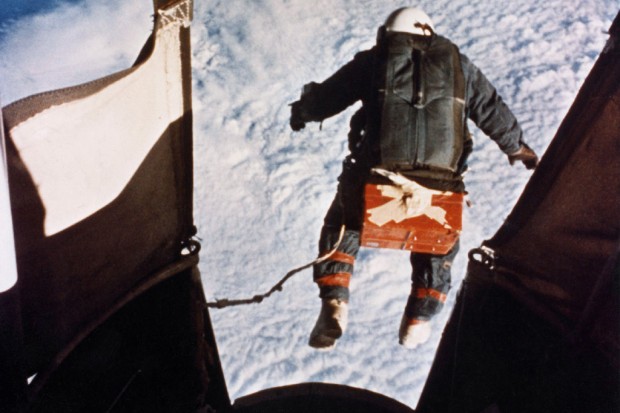
Joe Kittinger Skydives From 102,800 Feet: August 16th in Aviation History

Joseph Kittinger's record-breaking skydive from 102,800 feet (31,300 m). (Photo by US Air Force)

2005: West Caribbean Airways Flight 708, a McDonnell-Douglas MD-82 (HK-4374X) suffers dual engine failure and crashes in a mountainous area of Venezuela while operating a charter from Panama City to Martinique, killing all 152 passengers and eight crew. The crash is blamed on ice buildup in the engines.

1987: Northwest Airlines Flight 255, an MD-82 (N312RC) crashes on takeoff from Detroit (DTW), killing all but one of the 155 people on board, as well as two people on the ground. The lone survivor is a four year old girl. The crash would be blamed on the crew’s failure to set the flaps for takeoff, and an electrical failure that prevented an alarm from sounding that would have warned the crew that the plane was not configured properly for takeoff.

1969: A new piston-engine airspeed record is set by Darryl Greenamayer in a heavily modified F8F Bearcat: 478 mph.

1960: US Air Force Colonel Joseph Kittinger skydives from a balloon at an altitude of 102,800 ft, setting a new world record.

1944: The world’s first and only successful rocket-powered warplane, Germany’s Messerschmitt Me 163, is used against enemy bombers for the first time.

1944: First flight of the Junkers Ju 287 takes place in Germany. The forward-swept winged, four-engined aircraft was a testbed for jet bomber technology, built mostly of parts salvaged from other aircraft. Before the second aircraft is completed, the Junkers factory is overrun by the Red Army. The Soviets would take the prototypes back to Russia for further development and create a derivative known as the OKB-1 EF 140, but the design is abandoned soon after.

1942: The 82nd Airborne is formed, becoming the US Army’s first paratrooper division. (It had formerly been a conventional division since 1917).

About the Author

NYCAviation Staff


Today in Aviation History: January 6

Happy birthday to Lufthansa! United Grounds Ted, the US Marines take delivery of their first AV-8 Harrier and more...
by NYCAviation Staff


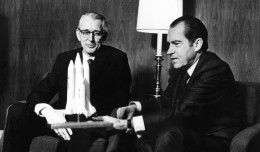
President Richard M. Nixon and Dr. James C. Fletcher, NASA Administrator, discuss the proposed Space Shuttle vehicle in San Clemente, California, on January 5, 1972. (Photo by NASA)

Today in Aviation History: January 5th

The Space Shuttle program is launched, Amelia Earhart is declared legally dead, Independence Air ceases operations, and more...
by NYCAviation Staff


The Apollo 17 spacecraft, containing astronauts Eugene A. Cernan, Ronald E. Evans, and Harrison H. Schmitt, glided to a safe splashdown at 2:25 p.m. EST on Dec. 19, 1972, 648 kilometers (350 nautical miles) southeast of American Samoa. The astronauts were flown by recovery helicopter to the U.S.S. Ticonderoga slightly less than an hour after the completion of NASA's sixth and last manned lunar landing in the Apollo program. (Photo by NASA)

Today in Aviation History: December 19th

The world's first airport opens near Paris, the last moon mission returns to earth, a Chalk's Ocean Airways crash is captured on video, and more...
by NYCAviation Staff


Today in Aviation History: December 16th

The midair collision of a United DC-8 and TWA Constellation over New York City, Concorde makes the first sub-3-hour Atlantic crossing, an Air Canada CRJ crashes, and more...
by NYCAviation Staff
726


Today in Aviation History: December 15th

In a near disaster, KLM Flight 867 loses all engines temporarily after flying through a cloud of volcanic ash, McDonnell Douglas and Boeing merge, the Boeing 787 makes its first flight, and more..
by NYCAviation Staff