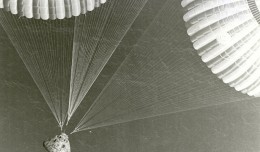
2001 – The robotic spacecraft Odyssey launches on its mission to orbit Mars, arriving at the planet the following October. The craft later collects data that would guess water to be on the plant. This is later confirmed by the Phoenix lander in July of 2008.
1999 – Turkish Airlines Flight 5904, a Boeing 737-400 on a ferry flight to Saudi Arabia, crashes in poor weather shortly after departure. It is suspected that the pitot static anti-ice system was not activated, creating false airspeeds that led to the deaths of all 6 on-board.
1994 – A TAAG Angola Lockheed L-100 (the civilian version of C-130 Hercules) (registration D2-THC) catches fire while taxiing to a parking spot in Malengue, Angola. All 4 occupants escape unharmed. The fire is blamed on overheated brakes.
1994 – A disgruntled Federal Express Flight Engineer, Auburn Calloway, unsuccessfully attempts to hijack and crash Federal Express Flight 705, a McDonnell Douglas DC-10-30 (N306FE) flying from Memphis to San Jose, Calif. While deadheading on the flight, Calloway uses a hammer in an effort to murder Captain David Sanders, First Officer James Tucker and Flight Engineer Andrew Peterson. The crew fights back, however, and despite suffering crippling head injuries, lands the plane safely. A former military pilot and Stanford University graduate, Calloway was facing dismissal from Federal Express due to irregularities in his reporting of flight experience. Calloway thought if he were to make the crash look like an accident, his family would be able to cash in on his $2.5 million life insurance policy. He is now serving two consecutive life sentences for attempted murder and attempted air piracy.
1983 – Space Shuttle Challenger astronauts Story Musgrave and Don Peterson perform the first shuttle-based spacewalk during the STS-6 mission.
1958 – AREA Ecuador Flight 222, a Douglas C-47 (DC-3) registered HC-ACL, crashes into a Chugchilan range of mountains after not maintaining the proper heading, resulting the fatalities of all 32 aboard.
1957 – A Varig Curtiss C-46 Commando (PP-VCF) crashes shortly after takeoff due to a fire in the left main gear wheel well. The pilot thought it was one of the engines, and shut it down unnecessarily. A go-around during a landing attempt when the gear doesn’t drop (due to the fire), allows more time for the fire to spread, leading to the left wing separating from the aircraft after the metal fatigue. All 40 aboard the aircraft perish.
1922 – The first midair collision of commercial airliners takes place over Thieuloy-Saint-Antoine, Picardie, France between a Farman F.60 (F-GEAD) and a de Havilland DH-18 (G-EAWO). At an altitude of about 500 ft in rainy weather, the two aircraft end up on a collision course with no time to evade each other. The Dash-18 loses its tail and a wing, while the Farman survives for a short while before also crashing. All seven people among the two aircraft die, including a young steward who initially survives the wreck, but succumbed to his injuries afterward.
1922 – The United States 1st Corps Observation Group makes its first patrol, becoming the first American aviation unit to enter action in Europe.