
On This Day in Aviation History

2012-07-30

TWA L-1011 Veers Off the Runway and Catches Fire at JFK: July 30 in Aviation History

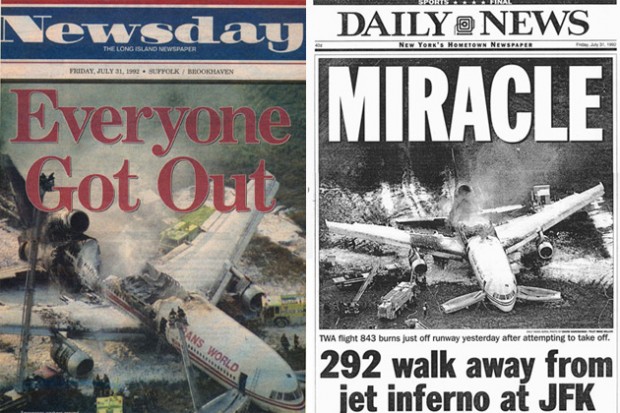
Covers of Newsday and the Daily News covering the TWA Flight 843 accident.

1992: TWA Flight 843, a Lockheed L-1011 Tristar (N11002) departing New York’s JFK Airport (JFK) for San Francisco (SFO), aborts takeoff shortly after liftoff, skids off the end of Runway 13R and burns. Despite the fire and only three available exits, all 280 passengers and 12 crew manage to escape with their lives. The NTSB would conclude pilot error was to blame for the accident, but witnesses say the plane was on fire before it lifted off. (Read the NTSB report.)

1971: All Nippon Airways Flight 58, a 727-200 (JA8329) collides with a Japan Air Self-Defense Force F-86F fighter jet (92-7932) 26,000 feet above Shizukuishi, Japan, killing all 162 on board the airliner. The fighter pilot ejected and survived. At the time it was the deadliest air disaster in history.

1914: Norwegian pilot Tryggve Gran makes the first crossing of the North Sea by airplane, flying his Bleriot from Cruden Bay, Scotland to Revtangen, Norway. Unfortunately for Mr. Gran, Europe was focused on the conflagration which would become World War I, which had begun brewing a month earlier with the assassination of Archduke Ferdinand, and Gran’s feat received little attention.


About the Author

NYCAviation Staff


Today in Aviation History: January 6

Happy birthday to Lufthansa! United Grounds Ted, the US Marines take delivery of their first AV-8 Harrier and more...
by NYCAviation Staff


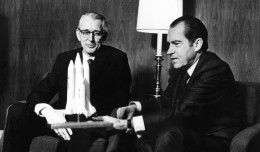
President Richard M. Nixon and Dr. James C. Fletcher, NASA Administrator, discuss the proposed Space Shuttle vehicle in San Clemente, California, on January 5, 1972. (Photo by NASA)

Today in Aviation History: January 5th

The Space Shuttle program is launched, Amelia Earhart is declared legally dead, Independence Air ceases operations, and more...
by NYCAviation Staff


The Apollo 17 spacecraft, containing astronauts Eugene A. Cernan, Ronald E. Evans, and Harrison H. Schmitt, glided to a safe splashdown at 2:25 p.m. EST on Dec. 19, 1972, 648 kilometers (350 nautical miles) southeast of American Samoa. The astronauts were flown by recovery helicopter to the U.S.S. Ticonderoga slightly less than an hour after the completion of NASA's sixth and last manned lunar landing in the Apollo program. (Photo by NASA)

Today in Aviation History: December 19th

The world's first airport opens near Paris, the last moon mission returns to earth, a Chalk's Ocean Airways crash is captured on video, and more...
by NYCAviation Staff


Today in Aviation History: December 16th

The midair collision of a United DC-8 and TWA Constellation over New York City, Concorde makes the first sub-3-hour Atlantic crossing, an Air Canada CRJ crashes, and more...
by NYCAviation Staff
726


Today in Aviation History: December 15th

In a near disaster, KLM Flight 867 loses all engines temporarily after flying through a cloud of volcanic ash, McDonnell Douglas and Boeing merge, the Boeing 787 makes its first flight, and more..
by NYCAviation Staff


  • I wanted to refresh a page times to evaluate this page for reasons unknown, however, the info here ended up being worth this wait.

  • Jean-Francois Dufrasne

    I was on the 843 from TWA. The pilot should never have been blamed for the crash, the tail engine was burning way before take off (people were running the alleys from behind before take off). William Kincaid and his crew saved 292 people that day. One fireman told me later that day that they thought they would only find corpses when he first saw the situation…